Best LED reef lights under $200: what actually grows corals
This post contains affiliate links. As an Amazon Associate, I earn from qualifying purchases at no extra cost to you.
Why Your Reef Tank Stops Growing Under Cheap LED Lighting
Underlit tanks are failing tanks. You’ll see it first in the corals: slow growth, color fading, polyps not extending fully. Your Acropora or Montipora stops putting on branches. Your Lobophytum leather coral loses its vibrant fluorescence. The problem isn’t your husbandry - it’s that your light isn’t delivering enough photosynthetically active radiation (PAR) to drive photosynthesis in symbiotic zooxanthellae.
Here’s the misconception: reef lights are expensive. The best ones at boutique price points can run $400 to $1,000. But you don’t need to spend that much. Three solid options will grow corals reliably at under $200, and the differences between them come down to your tank size, coral type, and whether you’re prioritizing full-spectrum growth or actinic aesthetics.
The reality is that most undersized lighting comes from choosing a light built for ornamental glow rather than photosynthetic intensity. You need to understand what PAR means, what color spectrum your corals actually need, and how to position the light so it reaches your corals - not your substrate. Do that right, and you’ll grow soft corals, LPS (Favia, Euphyllia), and beginner SPS species on a tighter budget than people think. You’ll also need a basic aquarium timer (usually $15–25) to maintain a consistent photoperiod, which is non-negotiable for healthy growth.
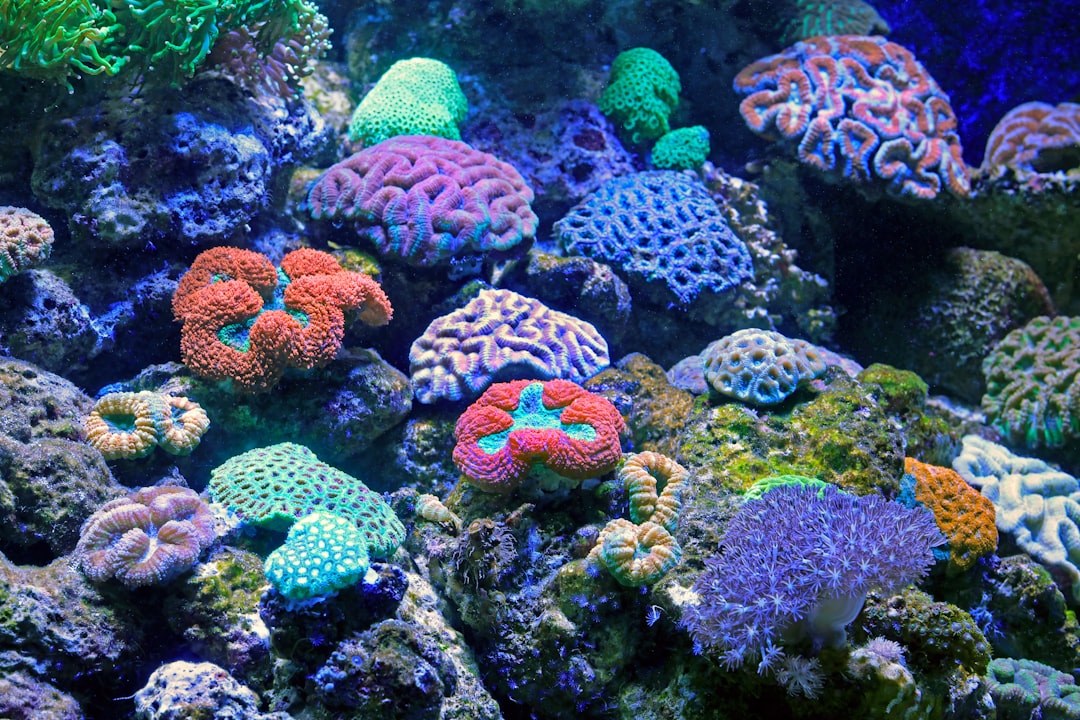
Photo by David Clode on Unsplash
Understanding the Specs Behind LED Reef Lights Under $200
Most reef keepers eyeball lights and buy based on wattage alone. Wrong move. Wattage tells you power consumption; it says nothing about the light actually reaching your corals. What matters is PAR (photosynthetically active radiation), measured in micromoles per square meter per second, or μmol/m²/s.
Different corals need different PAR ranges:
- Soft corals and mushroom anemones (Lobophytum, Sinularia, Ricordea): 50–150 μmol/m²/s
- LPS (large polyp stony) corals (Euphyllia, Catalaphyllia, Favia): 100–250 μmol/m²/s
- Beginner SPS (small polyp stony) corals (Montipora, Acropora millepora): 200–400 μmol/m²/s
- Advanced SPS (A. digitata, A. valida): 350–500+ μmol/m²/s
Budget LEDs usually deliver 100–250 μmol/m²/s depending on tank size and distance from the light. That’s enough for soft corals and entry-level LPS and SPS. If you want to scale up to demanding SPS eventually, you’ll outgrow a $200 light, but you don’t start there anyway.
Color spectrum matters too. Corals derive energy from blue (400–500 nm) and red (600–700 nm) wavelengths. A “full spectrum” light balances these, plus white (5,000–7,000 K) for viewing and plant growth in refugiums. A light skewed too far toward blue will look beautiful but underperform on growth. A light heavy on white and deficient in red will grow slower-growing species poorly. The best budget reef lights split the difference, offering 70% white with 20% blue and 10% red - or let you adjust intensity separately for each channel if they’re dimmable.
Finally, verify the light spreads evenly across your tank. Budget LEDs often have narrower beam angles, which is fine for 24-inch tanks but creates dark corners in a 36-inch setup. Taller fixtures help, or you position the light closer to the water surface and accept slightly higher intensity to maintain even distribution.
The Three Best LED Reef Lights Under $200: Detailed Comparison
You’re choosing between two NICREW options and one specialty accent light from Kessil. All three will grow corals under $200. The trade-off is tank coverage versus spectrum specialization.
| Feature | NICREW NavaReef 65 | NICREW HyperReef 100 Gen 1 | Kessil A80 Tuna Blue |
|---|---|---|---|
| Power | 65W | 100W | 35W (actinic-focused) |
| Tank Size | 24–30” | 30–40” | 12–18” or actinic supplement |
| PAR (center, 12” depth) | ~150–200 | ~250–300 | ~80–120 (blue-dominant) |
| Spectrum | Full (white + RGB dimmable) | Full (dimmable) | Narrow (actinic blue) |
| Intensity Control | RGB separate dimming | Dimming | N/A |
| Best For | Soft/LPS, small tanks | Soft/LPS/beginner SPS, medium tanks | Aesthetics & actinic enhancement, SPS accent |
| Price Range | $90–130 | $120–180 | $80–120 |
The NICREW NavaReef 65 is your entry point. Grab one for a standard 20-gallon long or a 24-gallon reef tank. It delivers ~150–200 μmol/m²/s at 12 inches from the surface - enough for soft corals, Favia, and Goniopora. The built-in RGB control means you can dial down the blues at night to reduce light shock for nocturnal species and adjust color temperature for your photo setup. It runs about $100–130.
The NICREW HyperReef 100 Watts Gen 1 is the workhorse. This is the light you pick up if you’re running a 30–40 gallon tank or want to cover a 36-inch dimension with room for beginner SPS like Acropora millepora or Montipora digitata. It delivers ~250–300 μmol/m²/s at 12 inches and has full-tank dimmability, not just RGB separation. You’ll spend $120–180, but the spread is more even than the 65W. This is the one most people should start with if they’re undecided.
The Kessil A80 Tuna Blue is a different animal entirely. It’s an accent light - a narrow-beam, actinic-heavy fixture that excels at maximizing fluorescence in corals and creating stunning blue-heavy aesthetics. At 35W, it doesn’t generate high PAR in absolute terms (~80–120 μmol/m²/s at 12”), so don’t use it as your only light unless your tank is very small (12–18 gallons). Use it as a secondary light over a frag tank or over a specific coral garden. The Tuna Blue costs $80–120, and if you’re serious about coral photography or want deeper blues in your display, it earns its place. But for beginners, start with a full-spectrum NICREW and add the Kessil later if you want more blue without sacrificing growth.
Matching LED Intensity and Spectrum to Coral Species
The first question you need to answer: what are you actually keeping? This determines which light you need and how deep you can push the intensity.
Soft corals like Lobophytum, Sinularia, Catalaphyllia, and Alcyonium are forgiving. You can even frag and propagate soft corals to build your collection over time. They’re adapted to murky reef environments where light is scattered and diffuse. You can light them at 50–150 μmol/m²/s and they’ll thrive. Pair them with Ricordea mushroom anemones, which prefer 75–120 μmol/m²/s, and you have a low-maintenance display that grows on either the NavaReef 65 or HyperReef 100 at moderate intensity. These corals don’t care if your light is slightly blue-heavy or white-heavy - they’re opportunistic.
LPS corals (Favia, Trachy *, *Euphyllia, Goniopora) want 100–250 μmol/m²/s. Most are from reef slopes where light reaches the substrate but isn’t intense. They’re photosynthetic but also aggressive feeders, so they survive supplemental feeding even under modest light. The HyperReef 100 at 50–75% intensity covers this beautifully. You’ll see strong growth on Favia heads and full polyp extension on Euphyllia corals.
Beginner SPS species—Acropora millepora, A. echinata, Montipora digitata, M. capricornis—demand 200–350 μmol/m²/s. These are branch builders; they invest energy in growth rather than survival. You need the HyperReef 100 at full or near-full intensity, positioned 12–14 inches above the waterline, to hit target PAR. If you’re starting with SPS, don’t rely on the NavaReef 65 alone. You’ll notice slower branch elongation and color bleaching if light drops below 200 μmol/m²/s.
Advanced SPS like Acropora valida, A. digitata, A. hyacinthus, and deepwater species need 350–500+ μmol/m²/s. Neither budget light alone will cut it - you’d layer the Kessil A80 over the HyperReef 100 or run two HyperReef 100s. Don’t attempt this if you’re new to reefing.
One final note: stacking lights works. If you’re uncertain and running a standard 40-gallon breeder or similar, buy one HyperReef 100 and position it 14 inches above the tank. If your corals respond well - growth, coloration, polyp extension - you’re done. If they stagnate, add a NICREW NavaReef 65 as a secondary or swap to two HyperReef 100s. This modular approach keeps your upfront cost down and lets you scale as your skill increases.
Common Lighting Mistakes That Kill Reef Corals
Most beginners don’t fail because they buy the wrong light. They fail because they position it wrong, run it too bright too fast, or ignore photoperiod consistency.
Mistake 1: Placing the light too high. You bought a 100W light and mounted it 24 inches above the waterline thinking you’d get even spread. Wrong. Every 6 inches of distance, light intensity drops by roughly 25–30% due to the inverse-square law. That 250 μmol/m²/s light at 12 inches becomes 150 μmol/m²/s at 18 inches and 80 μmol/m²/s at 24 inches. If you’re trying to grow SPS, mounting your HyperReef 100 too high will create a slow-growth nightmare. Mount it 12–14 inches above the water surface for a 30–40 gallon tank. If mounting height is fixed and high, accept that you’re limited to soft corals and LPS.
Mistake 2: Ramping intensity too fast. Your new light arrives, you install it, you set it to full brightness on day one. Three weeks later, your corals are bleached white and dying. Photoadaptation is real. Corals kept under dim aquarium lighting at the store or under weak LED before need time to adjust to higher PAR. Ramp the light in 10% intensity increments over 2–3 weeks. Start at 30% brightness on the NICREW dimmers and increase by 10% every 3–4 days. Your corals will harden (develop richer pigmentation and more robust zooxanthellae populations) instead of bleaching.
Mistake 3: Running lights for 24 hours or changing photoperiod erratically. Corals depend on circadian rhythms. A consistent 8–10 hour photoperiod (not 24/7) ensures healthy metabolic cycling and reproductive behavior. More importantly, erratic photoperiods—6 hours one day, 12 hours the next - stress corals and suppress growth. Set up a basic outlet timer. Most run under $30. Pick a photoperiod (9 hours is solid for mixed displays) and stick to it. Your corals need predictability more than they need long hours.
Mistake 4: Ignoring water chemistry while upgrading light. Here’s the trap: you install a powerful light, corals start growing aggressively, and suddenly your alkalinity crashes and calcium plummets. Corals under high PAR calcify faster (they’re building more skeleton). If your water chemistry isn’t stable - alkalinity at 8–12 dKH, calcium at 400–450 ppm, magnesium at 1,250–1,350 ppm - that new growth stalls mid-build and corals suffer bleaching or tissue recession. Don’t upgrade your light without ensuring your two-part dosing (or auto-doser) is running. A reef light reveals husbandry gaps it doesn’t create them.
Mistake 5: Mounting a light that’s too narrow for your tank. The Kessil A80 has a tight beam angle - great for focus, terrible for even coverage in a 36-inch tank. If you buy a narrow-beam light for a large display expecting full tank coverage, expect dark corners and uneven growth. Use wide-beam lights (NICREW fixtures have better spread) or accept that narrow-beam lights need secondary fixtures. The HyperReef 100’s wider beam makes it more forgiving for standard dimensions.
Installation, Positioning, and Adjusting Your Reef Light
Getting a light into the water correctly isn’t complicated, but sloppy installation cuts PAR delivery by 15–30%.
-
Choose your mounting height. Measure from the water surface (not the rim) to your tank’s substrate. For a standard 12-inch water column in a 20-gallon long, mount the light 12 inches above the waterline. For a 24-inch deep tank, mount it 14 inches above the surface. This puts the light roughly 26 inches from the substrate and delivers 200–300 μmol/m²/s depending on fixture wattage. Use an adjustable light stand or drill mounting holes into your canopy (if acclimating to a fixed setup is acceptable).
-
Ensure horizontal centering. If you have a 36-inch tank and a single light, position it over the center 24–30 inches of the tank. Don’t position it at one end - you’ll create a gradient from 280 μmol/m²/s at the light’s position to 100 μmol/m²/s at the far end. Corals slow growth in low-light zones. Either position centrally or use two fixtures.
-
Install a splash guard or keep the light dry. LED fixtures are sealed, but salt spray accelerates corrosion on mounting brackets and electrical connectors. Position the light to avoid direct splash, or use a plastic diffuser panel (usually $15–30) between the light and waterline.
-
Connect the dimming cable and outlet timer. If your light has an adjustable control (like the HyperReef 100 or NavaReef 65), run the cable to a power outlet controlled by a timer. Program the timer for your chosen photoperiod—9 AM to 6 PM is standard, or 2 PM to 11 PM if you’re keeping nocturnal corals like Goniopora. Consistent timing matters more than specific hours.
-
Set initial intensity at 30–40% and ramp slowly. Never start a new light at full power. Set the dimmer (if available) to 30% for the first week. Observe polyp extension, coloration, and tissue health. If corals look stressed (withdrawn polyps, pale color), hold intensity for 3–5 more days. If they look happy (extended polyps, vibrant coloration), increase by 10% every 3 days until you reach your target intensity. Full intensity reached over 3 weeks prevents bleaching.
-
Check for even spread. Observe where light hits the tank. If you see bright spots and dark zones, reposition the fixture higher (spreads light wider but reduces intensity) or add a second light. For most 40-gallon displays, one HyperReef 100 at 14 inches creates acceptable even coverage. For 55-gallon and larger tanks, plan on two fixtures or a combination light-and-actinic setup.
Budget Versus Premium: What You Actually Need and What’s Overkill
The $1,000+ premium lights (Radion, some AI Hydra models) deliver marginally better spectrum control and finer dimming curves. For your wallet, the question is whether those gains justify the price. For most reef keepers running soft corals and beginner SPS, they don’t.
A NICREW HyperReef 100 Watts Gen 1 under $200 delivers 250–300 μmol/m²/s and grows everything except deepwater SPS. Premium fixtures deliver similar PAR but with more granular intensity steps and occasionally better spectral tuning. You’re paying for refinement, not fundamentals. Unless you’re running an SPS-only display of A. valida and A. digitata, you don’t need premium.
Where premium does make sense: if you’re keeping a very large tank (60+ gallons) where multiple fixtures become necessary, premium lights (especially dimmable multi-spectrum rigs) consolidate control into one app or interface. But if you’re reading this, you’re not that person yet. Start with a budget light. Sell it later when you upgrade. You’ll get 30–40% of your money back on the used market.
One last reality check: a $150 light, combined with stable water chemistry, good husbandry, and consistent photoperiod, outperforms a $500 light combined with erratic dosing and 14-hour photoperiods. Light is one variable. Get the other variables right first. The budget light will prove it.
FAQ
How do I know if my LED light is delivering enough PAR to my corals?
The reliable way is to use a PAR meter - a device that measures photosynthetically active radiation in micromoles. Entry-level PAR meters (like the Seneye or DIY spectrometer options) cost $150–300. If that’s out of reach, use manufacturer specs as a baseline: a NICREW HyperReef 100 delivers 250–300 μmol/m²/s at 12 inches from the surface. Verify your mounting height (measure from the waterline) and position any color-challenged or slow-growing corals within that distance. If corals stagnate after 4 weeks at stable intensity and chemistry, the light isn’t sufficient - add a secondary fixture. If corals thrive (visible branch growth on SPS, full polyp extension on soft corals, vibrant coloration), your light is working. Behavior is your best PAR meter.
Can I use a full-spectrum reef light with plants in my refugium, or do I need a separate grow light?
Full-spectrum lights (like the NICREW fixtures) work fine for refugium macroalgae and seagrass, but they’re optimized for coral photosynthesis, not plant growth. Macroalgae like Chaetomorpha and Caulerpa benefit from higher red wavelengths (600–700 nm) than reef lights typically emphasize. If your refugium is under the main display light, it’ll function, but growth will be slower than under a dedicated plant-heavy 6,500K LED. If the refugium is separate, pick up a standard 6,500K LED grow light (~$40–80) instead. It’ll grow macroalgae faster and cost less than a premium reef light. The Kessil A80 Tuna Blue is a poor choice for refugium lighting - its actinic bias doesn’t drive macroalgae growth.
What’s the difference between dimmable and non-dimmable lights, and is dimming essential?
Dimmable lights let you adjust intensity over time, usually via a knob or app. Non-dimmable lights run at fixed intensity once powered on. Dimming isn’t essential if your tank has a fixed photoperiod and stable setup, but it’s practically useful for photoperiod ramp-up (preventing bleaching when you first install the light), seasonal adjustments, and fine-tuning intensity after 8 weeks when you understand your corals’ true PAR needs. The HyperReef 100 is dimmable; some budget NICREW models vary. If you have the option, choose dimmable - it adds flexibility for under $10 in total cost and solves common beginner mistakes like over-intensity on day one. It’s the difference between a light that forces you to learn and a light that lets you experiment safely.
How often should I replace an LED reef light, and when should I upgrade?
Modern aquarium LEDs last 30,000–50,000 hours (roughly 10–15 years of normal use). You’re replacing the fixture due to technological improvement or tank needs before the LED fails. Plan to upgrade when: (1) you exceed the light’s PAR ceiling and stagnate on demanding corals, (2) a secondary light becomes necessary and it’s cheaper to upgrade than stack, or (3) reliability issues emerge (flickering, dimmer failure). Most hobbyists replace lights every 5–7 years voluntarily. Used NICREW fixtures hold value, so selling your budget light makes upgrading affordable.
Your Next Move
You now know what PAR is, which three fixtures work under $200, and how to position them without bleaching corals. Install your light at 12–14 inches, ramp the intensity over 3 weeks, and match your coral types to the resulting PAR. If you’re keeping soft corals, the NavaReef 65 is plenty. If you want faster-growing LPS and beginner SPS, the HyperReef 100 is the safe bet. If you want actinic enhancement or an SPS accent later, add the Kessil A80 as a secondary.
Start with stable water chemistry and a consistent photoperiod. The light will reveal every other mistake in your system. Fix the chemistry, keep the photoperiod predictable, and your corals will show you exactly how much light is enough.
Bookmark this post or subscribe for updates on lighting specs. New fixtures come out regularly, and we track which ones deliver PAR on budget.
The ReefCraft Guide team researches saltwater aquarium keeping, drawing on community-tested methods, manufacturer data, and published marine biology literature. Our guides explain why something works - not just what to do.
</div>