SPS Coral Basics: Water Quality and Flow Requirements
This post contains affiliate links. As an Amazon Associate, I earn from qualifying purchases at no extra cost to you.
SPS corals are the crown jewel of reef keeping. Acropora, Montipora, Pocillopora, and their relatives produce the intricate branching and plating structures that define a mature, high-performing reef tank. But they come with a reputation for being unforgiving. Unlike soft corals or most LPS, SPS corals have almost no tolerance for chemical swings. A parameter that drifts slightly in the wrong direction for a few days can bleach a colony that took months to grow.
The good news: SPS corals are not difficult to keep if your system is stable. The goal is not perfection on any given test reading. It is consistency across all readings, day after day. In our experience running SPS-dominated tanks, the hobbyists who struggle with these corals are almost always fighting instability rather than wrong target values.
This guide covers the water chemistry targets that matter, the flow dynamics SPS corals need, how to test reliably, and the most common ways reefers accidentally crash their SPS before they figure out what went wrong.
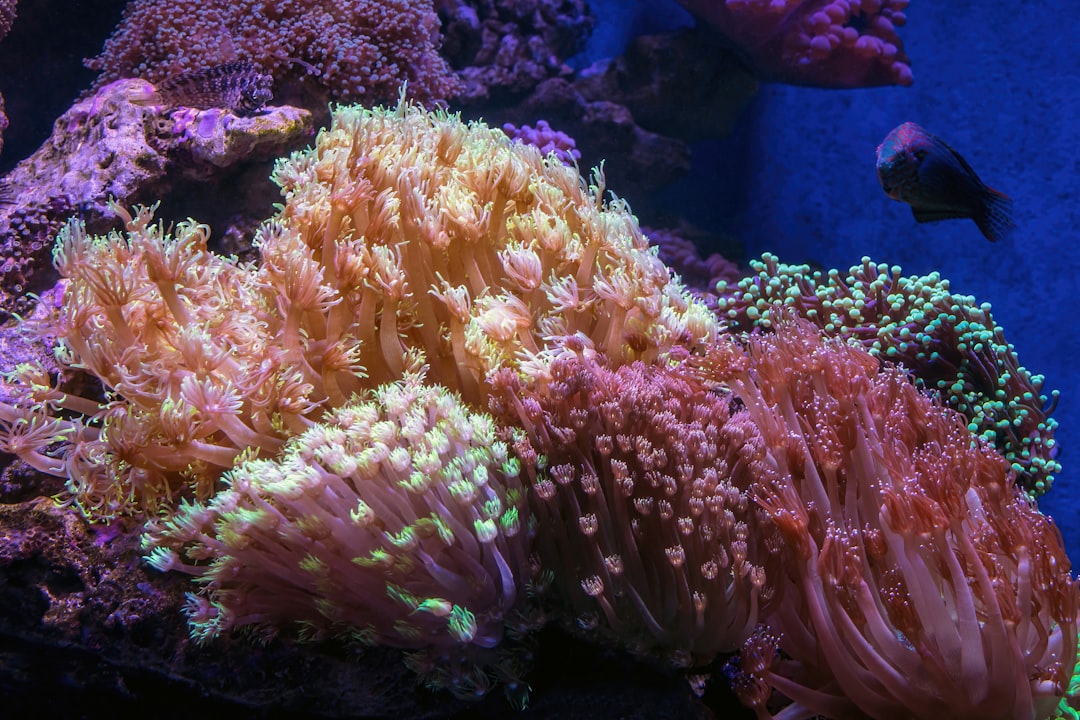
Photo by David Clode on Unsplash
What Makes SPS Corals Different from LPS and Softies
SPS stands for “small polyp stony” coral. The “stony” part is the defining characteristic: SPS corals build hard calcium carbonate skeletons, and they build them quickly. Acropora, the most demanding genus, can grow several inches per year in ideal conditions. That growth requires a constant, large supply of calcium, carbonate (alkalinity), and magnesium from the water column.
Soft corals have no hard skeleton and tolerate a wide range of water conditions. LPS corals (large polyp stony) do build skeletal structures, but their polyps are large and fleshy enough to handle minor parameter swings. SPS corals have tiny polyps covering a dense skeleton. Because the skeleton is so dense and grows so fast, the demand on your water chemistry is much higher and far less forgiving of gaps in maintenance.
There is also a biological difference in how SPS corals feed. Their zooxanthellae algae (symbiotic algae living in the coral tissue) are highly productive and require strong, consistent lighting and good water clarity to function. Simultaneously, SPS corals capture microfauna from the water. This dual feeding mode means they are sensitive to both water chemistry and water movement. Stagnant water prevents them from feeding and can allow waste to accumulate on the coral surface, which leads to tissue necrosis.
The practical takeaway: if you are keeping soft corals or easy LPS like hammer or torch coral, you can be somewhat flexible with your schedule. If you add SPS, you are committing to a more regimented maintenance routine. It is not a difficult routine, but it has to be consistent.
Water Chemistry Targets for SPS Corals
These are the parameters that SPS corals depend on most. Values outside these ranges do not guarantee failure, but they significantly increase the risk of stress, bleaching, or tissue loss.
Calcium (Ca): 420 to 450 ppm
Calcium is the primary building block of coral skeletons. SPS corals consume calcium rapidly, and in a heavily stocked tank, a single week without dosing can pull levels down by 20 to 30 ppm. Low calcium slows skeletal growth and weakens tissue. Very low calcium (below 380 ppm) causes stress responses that present as paleness or polyp retraction before visible bleaching occurs.
A target of 420 to 450 ppm works well for most SPS setups. Some reefers push to 460, but the risk of precipitation (calcium and alkalinity spontaneously precipitating out of solution as calcium carbonate) increases above 450 ppm, especially if alkalinity is also elevated. Keep calcium and alkalinity in balance.
Alkalinity (dKH): 8 to 10 dKH
Alkalinity is the parameter that kills the most SPS corals. It is consumed in large quantities, fluctuates faster than calcium, and is harder to maintain stable without a deliberate dosing strategy. A swing of 2 dKH over 24 hours is enough to visibly stress Acropora. A swing of 3 to 4 dKH sustained over several days will bleach them.
We recommend targeting 8 to 9 dKH for most SPS systems. Some high-growth, high-light systems run 10 to 11 dKH, but this requires even tighter monitoring. If you are new to SPS, stay at the lower end of the range. Consistency matters more than the exact value.
Magnesium (Mg): 1250 to 1350 ppm
Magnesium is not consumed as rapidly as calcium or alkalinity, but it plays a critical role in keeping calcium and alkalinity in solution. Low magnesium (below 1200 ppm) causes calcium and alkalinity to precipitate out of the water prematurely, meaning your test readings may look acceptable but the available minerals are actually less than they appear. Magnesium also affects the growth structure of coral skeletons.
Test magnesium monthly in most systems. In tanks that dose calcium and alkalinity heavily, test every two weeks.
Salinity: 1.025 to 1.026 (35 to 36 ppt)
Natural sea water runs at 1.025 to 1.026 specific gravity, and SPS corals are adapted to that range. Evaporation raises salinity quickly in smaller tanks. An auto top-off (ATO) system is essentially mandatory for a serious SPS system. Daily manual top-offs can work but introduce the risk of inconsistency. Even 0.001 salinity swing per day adds up to meaningful stress over a week.
Temperature: 76 to 79°F (24.5 to 26°C)
SPS corals are vulnerable to temperature spikes above 82°F, which trigger bleaching rapidly. Sustained temperatures above 80°F slow tissue growth and increase susceptibility to disease. In summer months, lighting heat and room temperature can push reef tanks higher than expected. A chiller, fan, or basement sump may be necessary depending on your climate.
pH: 8.1 to 8.3
pH is influenced heavily by CO2 in your home. It naturally drops at night when CO2 from respiration builds up in a sealed house, and rises during the day when fresh air circulates. SPS corals tolerate a daily swing between 8.0 and 8.3 reasonably well, but chronic low pH (below 8.0) slows skeletal growth and stresses tissue. A pH probe in your display tank, read with a controller or simple logger, helps you understand your tank’s natural rhythm.
| Parameter | Acceptable Range | Ideal for SPS | Notes |
|---|---|---|---|
| Calcium | 380-460 ppm | 420-450 ppm | Balance with dKH |
| Alkalinity | 7-12 dKH | 8-9 dKH | Stability is key |
| Magnesium | 1200-1400 ppm | 1250-1350 ppm | Affects Ca/Alk balance |
| Salinity | 1.024-1.027 | 1.025-1.026 | ATO recommended |
| Temperature | 74-82°F | 76-79°F | Avoid spikes above 80 |
| pH | 7.9-8.4 | 8.1-8.3 | Natural daily swing OK |
| Nitrate | 0-20 ppm | 1-10 ppm | Near-zero causes STN |
| Phosphate | 0-0.1 ppm | 0.03-0.07 ppm | Too low causes bleaching |
The NOAA Coral Reef Conservation Program provides a useful reference on the ocean chemistry that wild corals evolved in. Natural reef seawater maintains remarkably stable calcium and alkalinity year-round, which explains why SPS corals are poorly adapted to fluctuating conditions in captivity.
One point worth emphasizing: nitrate and phosphate should not be at zero in an SPS tank. Ultra-low nutrients cause SPS corals to expel their zooxanthellae and bleach just as effectively as high nutrients. Many beginners chase ultra-low nutrient levels and wonder why their SPS look pale. A small amount of both is beneficial.
Flow Requirements for SPS Corals
Water movement is not optional for SPS corals. It serves three functions simultaneously: delivering food and dissolved minerals to the coral’s surface, removing waste and detritus, and preventing the buildup of surface films on the coral tissue that block gas exchange.
Flow Rate Targets
For a mixed reef with some SPS, aim for 20 to 30 times turnover of your display tank volume per hour. For a dedicated SPS system, 40 to 50 times turnover is more appropriate. This does not mean you need a single pump capable of that flow. The goal is creating randomized, turbulent flow throughout the tank rather than a single strong current in one direction.
An Acropora colony placed in a unidirectional high-flow zone will thrive on the upstream side and die on the downstream side. The downstream side sees stagnant water relative to the upstream face. Randomized flow from multiple pumps, or from a wavemaker that reverses direction, ensures all surfaces of the coral receive circulation.
Placement Relative to Flow
SPS corals generally do better in upper and mid-tank positions where flow is strongest. However, sensitive colonies should not be placed directly in front of a powerhead output. Intense laminar flow blasting a single spot on an Acropora can cause tissue recession at the point of impact while the rest of the colony remains healthy. Aim for strong but diffuse flow.
Encrusting Montipora and plating Montipora are more tolerant of varied flow than Acropora. They can thrive in mid-tank positions where flow is moderate but consistent. Pocillopora and Stylophora sit between Montipora and Acropora in their requirements.
Powerhead and Wavemaker Options
The hygger Mini Wave Maker Aquarium Magnetic DC Powerhead is a compact and affordable option for adding randomized flow to smaller SPS systems (up to 75 gallons). The magnetic mount allows easy repositioning without draining the tank, and the variable speed control lets you dial in output. We have tested this in a 40-gallon breeder as a secondary wavemaker alongside a larger return pump, and the turbulence it creates is noticeably better than a single-direction powerhead.
For larger systems, consider purpose-built wavemakers from EcoTech (Vortech) or Tunze (Turbelle) that offer programming for alternating flow modes.
For more detail on positioning powerheads strategically, see our guide on powerhead placement and flow in reef aquariums.
Testing and Monitoring Your Parameters
Knowing your target values is only half the equation. The other half is knowing your actual values, reliably, on a regular schedule.
Test Frequency
For a new SPS system (less than six months old), test calcium, alkalinity, and magnesium every week until you have established a stable baseline. Once you know your daily consumption rate and your dosing is keeping up, you can extend to biweekly testing for calcium and magnesium and keep weekly testing for alkalinity. Alkalinity is the parameter that crashes fastest and causes the most damage, so it should always be tested most frequently.
Test nitrate and phosphate every one to two weeks. Test salinity daily if you use manual top-off, or every few days with an ATO.
Choosing a Test Kit
The Salifert Alkalinity Calcium Magnesium Combo Test Kit covers the three most critical parameters in one purchase. Salifert tests are widely used in the reef hobby and are considered a reliable mid-tier option. They are titrimetric tests, meaning you are counting drops and watching for a color change. The technique takes a few tests to master, but once you are consistent, the results are repeatable.
For the most accurate alkalinity results, consider a Hanna Instruments HI772 alkalinity checker, which is a photometric test with digital readout. The reagents are more expensive but the precision is higher, which matters when you are trying to catch a 0.5 dKH swing before it becomes a problem.
Never rely on test strips for SPS tanks. The margin of error is far too large to make useful dosing decisions.
Keeping a Log
Record your test results with dates. A simple spreadsheet or notebook works fine. Over time, a test log reveals trends: whether your alkalinity is drifting down between water changes, whether your calcium consumption accelerated when you added three new Acropora colonies, whether your phosphate spikes after feeding. These patterns are not visible from individual test readings.
Dosing and Maintaining Stable Parameters
The most common method for maintaining calcium and alkalinity in a moderately stocked SPS tank is two-part dosing. Two-part refers to two separate solutions: Part A raises calcium and Part B raises alkalinity. They are dosed in equal volumes, typically via a dosing pump on a timer.
Two-Part Dosing
Two Little Fishies C-Balance is a well-established two-part system that has been used in the hobby for decades. It buffers both calcium and alkalinity and is formulated to maintain a natural ionic balance in the water. The 1-gallon size covers most small to medium SPS systems for several weeks to a few months, depending on your coral load and consumption rate.
To use two-part effectively, you need to know your actual daily consumption. Test alkalinity at the same time on two consecutive days before dosing. The difference in dKH tells you how much your tank consumed in 24 hours. Use that figure to calculate how much two-part solution to add per day to replace what was consumed.
We recommend dosing in small amounts multiple times per day rather than one large dose once daily. Dosing pumps make this easy. Adding all of your daily alkalinity in one shot creates a localized spike near the outlet that can irritate corals in the vicinity.
Kalkwasser
Kalkwasser (calcium hydroxide) is an older method that doses calcium and alkalinity simultaneously through the top-off water. It has a higher pH than two-part, which can be beneficial for tanks that run chronically low pH. The drawback is that kalkwasser has a fixed ratio of calcium to alkalinity, so it cannot independently adjust either parameter. For a heavily consumed SPS system, two-part is generally more flexible. For a lightly stocked system, kalkwasser is elegant.
For a deeper comparison of these methods, our guide on dosing calcium and alkalinity: two-part vs. kalkwasser covers the tradeoffs in detail.
Calcium Reactors
A calcium reactor uses CO2 and slightly acidic water to dissolve coral rubble media, releasing calcium and alkalinity in proportions very close to natural seawater. Calcium reactors are the preferred method for large, heavily stocked SPS systems because they deliver consistent results with relatively low ongoing cost. The downside is the initial equipment cost and the learning curve for tuning the CO2 rate and effluent output.
For most hobbyists starting with SPS, two-part is the practical first step. Calcium reactors make sense once you have a system that regularly pushes the upper limits of what two-part solutions can replace cost-effectively.
Common Mistakes That Crash SPS Corals
Even experienced reefers sometimes lose SPS colonies to preventable causes. These are the mistakes we see most often.
Alkalinity Swings
This is the number one SPS killer. A swing of 2 or more dKH within a 24-hour period stresses Acropora significantly. A swing of 3 to 4 dKH can trigger rapid tissue necrosis (RTN), where the coral’s tissue peels back and dies within hours. RTN can take a thriving Acropora colony from healthy to skeleton in 24 to 48 hours.
The most common cause of alkalinity swings is inconsistent dosing: dosing multiple days’ worth at once after missing a day, or running out of two-part solution without noticing, or manually adding a large volume to compensate for a low reading. Automated dosing pumps on a timer largely eliminate this risk.
Overshooting Nutrient Export
Overshooting your protein skimmer, GFO reactor, or carbon dosing will pull nutrients too low. SPS corals with consistently undetectable nitrate and phosphate lose their zooxanthellae and bleach. If your SPS are turning pale or white from the base outward, test nitrate and phosphate before assuming it is a chemistry or flow problem. Near-zero nutrients are the diagnosis far more often than hobbyists expect.
Adding SPS Too Early
SPS corals do best in established systems with stable chemistry and an active microbial community. Adding Acropora to a system less than six months old significantly increases your risk of failure. The water chemistry swings more widely in new systems because the biological filtration is still maturing, and the dosing requirements are still being established. We have found that waiting until a tank is eight to twelve months old before adding demanding SPS makes a large difference in success rates.
Insufficient Flow
Placing SPS in a low-flow area of the tank is a slow way to lose them. Early signs include “tissue recession” starting at the base or in the interior of branching colonies, where dead zones accumulate. By the time the coral looks visibly bad, the interior tissue may have been receding for weeks. If you see RTN starting, increasing flow to the affected area sometimes slows the spread, but removing the cause early is always better.
Acclimation Shock
Moving a coral from one water chemistry to another too quickly causes stress. If you purchase a coral from a store or online seller whose alkalinity is 11 dKH and your tank runs 8 dKH, placing the coral directly in your tank exposes it to a 3 dKH drop instantly. Float the coral in a sealed bag or container for temperature acclimation, then drip acclimate slowly over 45 to 60 minutes to introduce your tank’s water.
Frequently Asked Questions
How do I know if my SPS coral is getting enough flow?
Polyp extension is the most reliable indicator. Healthy SPS corals in adequate flow extend their polyps fully, giving the colony a fuzzy, textured appearance. Corals in insufficient flow show limited polyp extension and may develop a slimy or mucus-coated surface as waste accumulates. If you see your SPS looking smooth or glassy rather than fuzzy, increase circulation in that zone. Also observe whether detritus settles on the coral surface during feeding. If it does, flow to that area is too low.
Can I keep SPS corals with LPS corals in the same tank?
Yes, but placement matters. Many LPS corals have aggressive sweeper tentacles that sting SPS if they are too close. Hammer coral, torch coral, and elegance coral all extend long tentacles at night that can reach SPS within six to twelve inches. Keep SPS in the upper portions of the rockwork and LPS at mid to lower levels with clear separation. The water quality requirements for LPS and SPS overlap enough that a mixed system is manageable, though SPS demands higher flow and more stable chemistry than most LPS require. See our LPS corals for beginners guide for more on what LPS need.
How quickly will parameters drop if I stop dosing?
It depends entirely on your coral load. A lightly stocked 75-gallon system might lose only 0.2 to 0.3 dKH per day, meaning a two-day gap in dosing has minimal impact. A heavily stocked 75-gallon SPS system might consume 0.5 to 1.0 dKH per day, meaning a two-day gap produces a noticeable and potentially damaging drop. Measure your consumption rate before relying on estimates.
What is the fastest sign that SPS is in trouble?
Polyp retraction is the first and fastest sign. Healthy SPS extend polyps continuously during the day. A coral under stress from chemistry, temperature, or aggression retracts its polyps, making the skeleton surface look smooth. If polyp retraction persists for more than 24 to 48 hours and you cannot identify a cause (recently moved, new addition nearby, equipment change), test all parameters immediately.
Do SPS corals need feeding?
SPS corals get the majority of their energy from their zooxanthellae through photosynthesis, so targeted feeding is less critical than for LPS. However, they do capture and benefit from fine particulate foods: copepods, phytoplankton, and coral foods formulated around 50 to 200 micron particle sizes. Regular feeding with coral-specific foods or a refugium producing live copepods supports tissue growth and coloration, especially in high-demand systems. This is not strictly required for survival, but it is beneficial for thriving.
What to Do Next
SPS corals reward the reefer who commits to consistency. The parameters are well established, the tools for maintaining them are widely available, and the diagnostic process for most common problems follows a logical pattern. Start with test kits, establish your baseline consumption rates, get dosing automated, and add flow in the upper portions of your display before purchasing your first Acropora.
If you are planning your first SPS purchase, we also recommend reviewing the coral placement guide for light and flow requirements to understand how to position new additions for the best results from day one.
Bookmark this guide for reference when you are troubleshooting parameter swings or setting up dosing for the first time. It covers most of what comes up in the first year of SPS keeping.